
Ancona and Napoleon
A journey through the places, stories, and figures of the Napoleonic era in Ancona.
Between 1796 and 1815, the history of Ancona became deeply intertwined with that of Napoleon Bonaparte. For nearly twenty years, the city was the stage for revolutions, sieges, urban transformations, and illustrious presences that changed its face forever.
Napoleon regarded Ancona as a crucial strategic point on the Adriatic, and he made this clear in his 1797 letter to the Directory, describing its port as essential for connections with Constantinople and Macedonia. The future emperor visited the city several times beginning in February 1797, staying at Palazzo Trionfi and at the villa of the Counts Camerata in Colle Ameno.
It all began with the arrival of French troops in 1796 and the birth of the Republic of Ancona (1796–1798), inspired by the values of the French Revolution. This was followed by the dramatic siege of 1799, which saw Russian, Turkish, Austrian, and insurgent forces pitted against the Napoleonic army barricaded within the city walls, and then by the period of the Napoleonic Kingdom of Italy (1808–1815), when Ancona became the capital of the Department of Metauro. During those years, the city effectively assumed the role of the kingdom’s second capital, owing to the frequent presence of Viceroy Eugène de Beauharnais, who had the Fortino built in the bay of Portonovo and stayed there to manage his considerable appanage.
Ancona was also home for extended periods to other members of the Bonaparte family and the so-called “Napoleonides,” well beyond the fall of the Empire: among them the future Emperor Napoleon III and his mother Hortense, who arrived in the city in 1831 during the revolutionary uprisings.
Numerous traces of that era remain in the urban fabric – forts, powder magazines, villas, works of art – while other celebrated sites, such as the sumptuous Palazzo Trionfi and the Palazzo dell’Appannaggio, survive only in historical memory, having been destroyed during the Second World War.
Today, the Municipality of Ancona is a member of the European Federation of Napoleonic Cities (FECN), a network of over 60 cities across 13 European countries that manages the cultural itinerary “Destination Napoleon,” certified by the Council of Europe. The membership, approved in 2024, launched an ongoing programme of rediscovery and enhancement of the city’s Napoleonic heritage, featuring an annual calendar of guided tours, lectures, historical re-enactments, and cultural initiatives.
Explore the map
The Napoleonic sites of Ancona
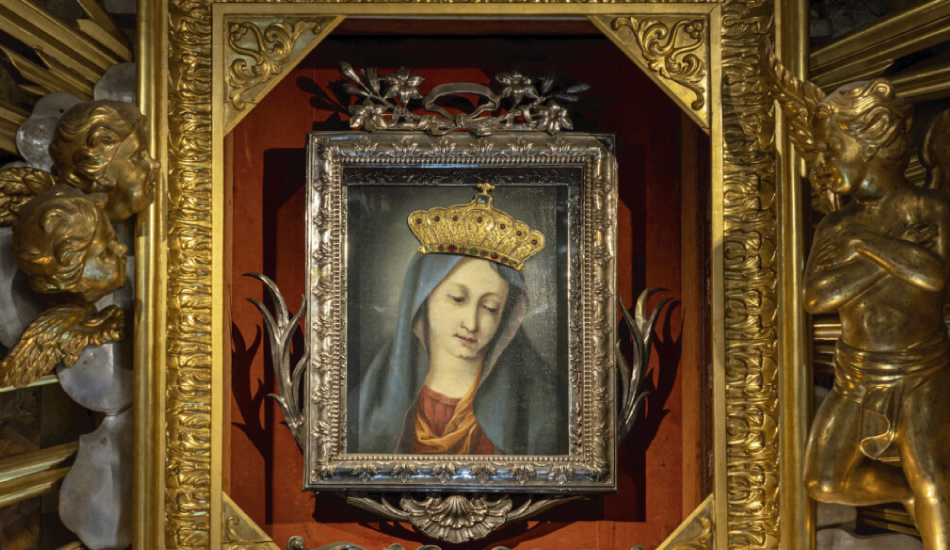
Madonna del Duomo
A painting by an unknown artist from the 16th century. The work is located in the left transept of the Cathedral and is housed in a marble aedicule designed by Luigi Vanvitelli in 1736.
The painting depicts the Madonna in a half-length portrait with a gold crown affixed above it as a sign of popular devotion. The canvas is set within a marble aedicule commissioned in 1736 by Bishop Bartolomeo Massei, designed by Luigi Vanvitelli, to contain the relics of the patron saints and to display the Sacred Image at its centre.
When news spread that the Peace of Bologna had granted the French possession of the city of Ancona, the people flocked to the Cathedral to pray before the sacred image of the Madonna for protection from the imminent danger. On 26 June 1796, some local women, while kneeling before the altar, began to stir, claiming that the Madonna had moved her eyes and smiled. Word spread through the city, and an unstoppable pilgrimage of townspeople towards the Cathedral began at once. The following day, the image was carried in procession, and many were the testimonies affirming the truth of the miracle.
On 11 February 1797, General Bonaparte, having arrived in Ancona and taken up lodgings at Palazzo Trionfi, learned of the miracle and summoned the two canons of the Cathedral responsible for the upkeep of the altar of the Madonna. He charged them with imposture and deceit aimed at inciting the people to rise against the French. The two clergymen rejected the accusations and managed to persuade the General to examine the Sacred Image himself.
The inspection was arranged for the evening of the following day, when, with great caution and without public notice, the painting was brought to Palazzo Trionfi and placed on a table in the main hall of the apartment, in full view not only of Napoleon but also of the officers of the General Staff, representatives of the municipality, and other members of his retinue.
The General took the canvas in his hands – it had been removed from its frame – and stripped it of its pearl crown, claiming he would give it as a dowry to a poor young woman. At that moment, those present noticed a visible disturbance in the General’s expression. Subsequently, pressed by the canons, he consented to the painting being returned to its original place, on condition that it be covered with a veil, to be removed only on Saturdays during the recitation of the Rosary and for the entire day only on major feast days.
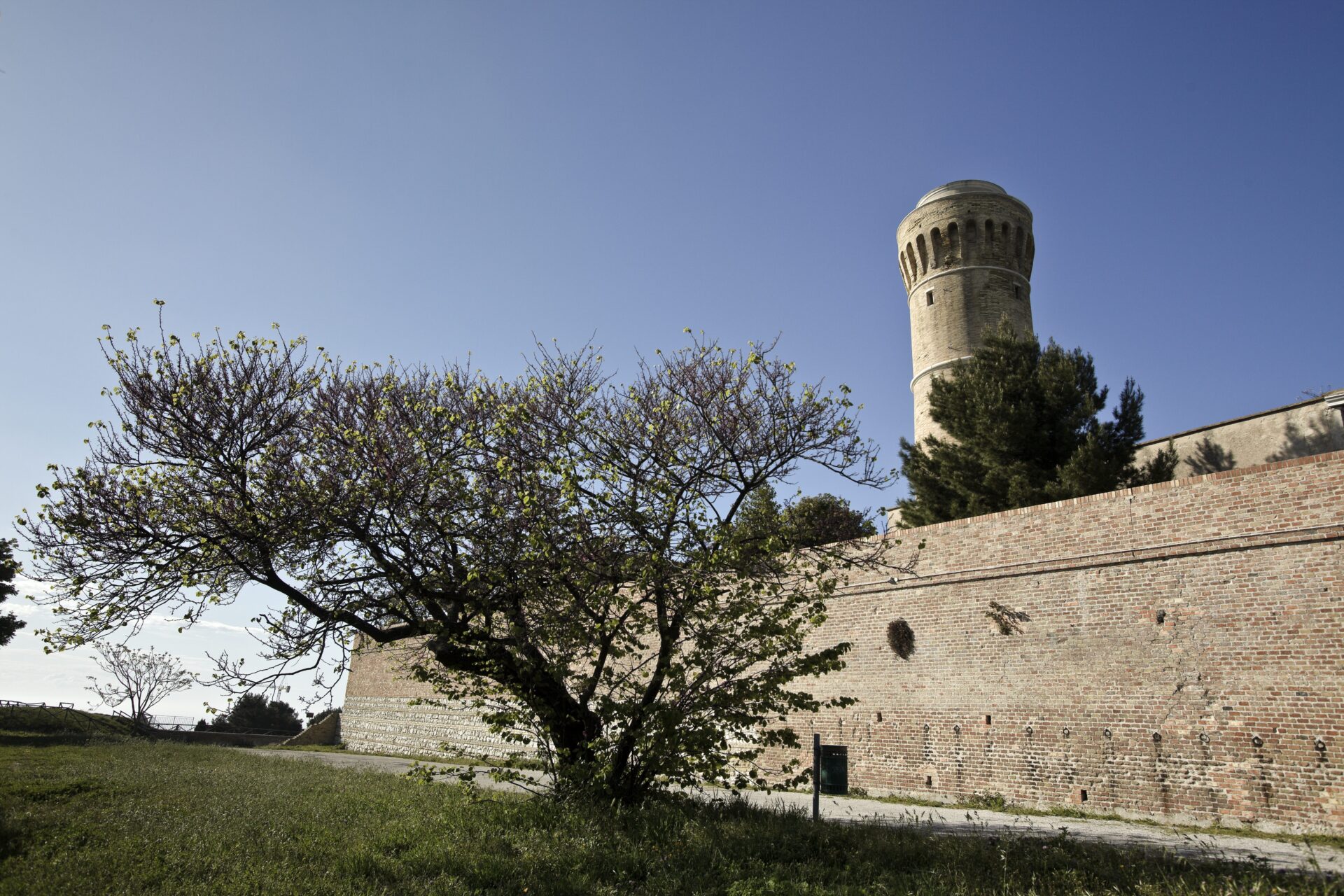

Forte Cardeto
Year of construction: 1808–1812.
Fort Cardeto consists of a curtain wall preceded by a ditch, over which the ramparts rise to a height of approximately five metres. The curtain is interrupted at the centre by a scarp that follows the contour of the terrain. The eastern side of the wall extends to the edge of the cliff, thus closing off any attempt at outflanking. The western side connects to the covered way leading to the Bastion of San Paolo. Beyond the ditch, a counterscarp wall was erected, which on the western side also contains vaulted chambers. An arrow-shaped ravelin projects towards the line of attack, directly in front of the fort’s scarp. The rear face features terracing traversed by the access road.
As early as 1575, Captain Latino Orsini, in a report addressed to Pope Gregory XIII concerning the defences of Ancona, lamented the lack of fortifications on Monte Cardeto, from which the city could be bombarded. It was not until the arrival of the French that a triple-walled field work was built there, which proved important during the siege of 1799. In 1807, Pierre Phébade Sevin de Talive (1767–1834) was appointed director of fortifications and drew up a defence plan for the city that included the construction of a fort on the summit of Cardeto hill.
The design was called into question by Napoleon himself, who disagreed with the proposal to arrange the defences on four sides as though the fort were situated on flat ground. In the Emperor’s view, the fort had only one front of attack, while the remaining sides were naturally defended by the sea cliff and the slopes of the hill. Following these directives, military engineer Captain Gouville prepared the final design. Construction began in 1809, employing approximately 500 men over several years. At the same time, the covered way connecting Fort Cardeto to the Bastion of San Paolo was built.
The fort played an important role during the sieges of Ancona by the Austrians in 1849 and by the Piedmontese in 1860.
In the new defensive layout the city assumed after joining the Kingdom of Italy, Fort Cardeto served as the main defence of the northern wing of the new city walls, which ran from Cardeto to the Lunette of Santo Stefano on the opposite side of the valley. By the end of the 19th century, once the need for a land-based defence of the city had subsided, the fort was converted into a depot and observation post and, during the First World War, an anti-aircraft position. It served the same purposes during the Second World War.
After being transferred to the Italian Navy, a radar station was installed on its summit, while the western slope was abandoned and sold to the Municipality of Ancona. Today, a small section remains in use by the Navy, while the main body of the fortified structures forms part of the public Parco del Cardeto.
Today it is part of the Cardeto Park, one of the most evocative spots in the city.

Lunette of Santo Stefano
Built in 1812 on the hill of Santo Stefano, on the edge of the Parco del Pincio, it was constructed according to the design of Pierre Savin de Talive, subsequently revised by Gouville – both officers of the French military engineers – on the basis of requirements identified on site during the building phase.
The result was a modified version of the Lunette d’Arçon (named after Michaud d’Arçon, 1733–1800, inventor of this type of fortification): a work composed of two faces and two flanks, built detached from the rest of the stronghold – a fortified outpost, yet one easily controlled from the bastions of the main fortress, since the rear face (gorge) is not enclosed and is defended solely by a small structure placed at its centre.
This structure takes the form of a two-storey tower, each level providing protection for the other. In its original design, the tower features galleries connecting it with the interior of the fortress and with the casemated counterscarps; however, these elements are absent in the Ancona fortification. In practice, since the nature of the terrain made it impossible to build a structure defended on all four sides, an arrowhead plan was adopted – well fortified on the front of attack but partially exposed at the gorge, the defence of which was entrusted to the tower. In the case of Ancona, the tower was replaced by a small barrack-like building fitted with loopholes covering the gorge and several gun embrasures also covering the front of attack.
After the withdrawal of the French, the city was temporarily occupied by the Austrians, who, upon leaving in 1815, blew up several military positions, including the Lunette. Once rebuilt, it played an important role in the defence of the city during the siege of 1849; however, subjected to bombardment from cannons positioned on Monte Pulito and Monte Marino, it was quickly captured by the besieging Austrians. It had no significance during the Piedmontese siege of 1860, as the main clashes took place on the opposite side of the city, towards the Lazzaretto and the railway station.
After the annexation of Ancona to the Kingdom of Italy and the decision to extend the city walls, the Lunette came to serve as a hinge between the new walls which, starting from Fort Cardeto, climbed up from the Valle degli Orti and, turning ninety degrees westward, connected with the Entrenched Camp of the Cittadella. The Lunette of Santo Stefano thus became a redoubt within the city, losing its original character as an outpost.
The new defensive techniques brought about by the technological advances in weaponry during the second half of the 19th century caused the slow but inexorable decline of fortifications built according to older defensive concepts. The Lunette of Santo Stefano was no exception to the gradual abandonment of former military positions: it lost its function in the early decades of the 20th century, when the walls connecting it to Cardeto were partially demolished. Ownership subsequently passed to the Municipality of Ancona, which retains it to this day.

Palazzo Trionfi (no longer extant)
It stood in what is now Piazza della Repubblica, to the left of the Theater of the Muses F. Corelli.
It was the result of the complete reconstruction of an entire city block, the existing dwellings of which were progressively acquired in the first half of the 18th century by Francesco Trionfi, until in 1750 work began on the construction of the palace. This was a particularly prosperous period for the city, and the family, with the building of their sumptuous residence, sought to give a visible sign of the standing they had achieved and of their investiture with the marquisate of Fiumesino.
The façade overlooked the square of the Teatro delle Muse and was divided by pilasters rising from the lower level with Ionic capitals. The windows of the piano nobile, enriched by pediments and cornices, were adorned with sculptural decorations. Two large entrance gates opened onto the street, while the rear of the building faced the port. It was the most sumptuous palazzo in the city, with 158 rooms, of which 25 were reception halls and bedchambers, in addition to a private chapel.
Besides the Trionfi family, the palazzo hosted distinguished figures passing through the city, including Napoleon Bonaparte, Joachim Murat, and royal princes of the House of Savoy. Divided among various heirs, it was sold in its entirety to different buyers in 1938.
During the Allied bombing of 25 April 1944, it was struck on the side facing the Scalo Vittorio, leaving the monumental staircase exposed. After the liberation of the city, it was completely demolished on the orders of the Allied Command to facilitate access to the port.
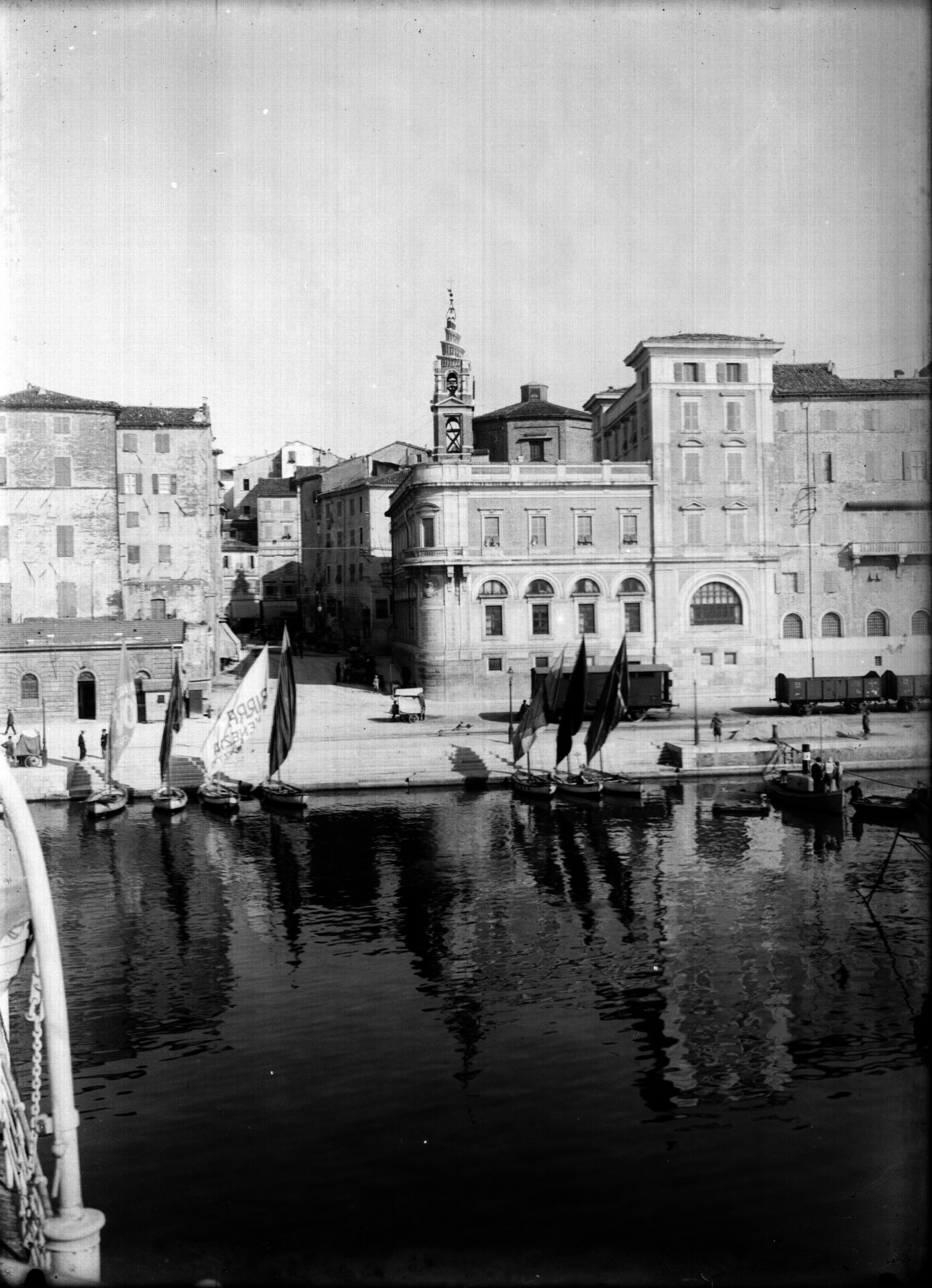
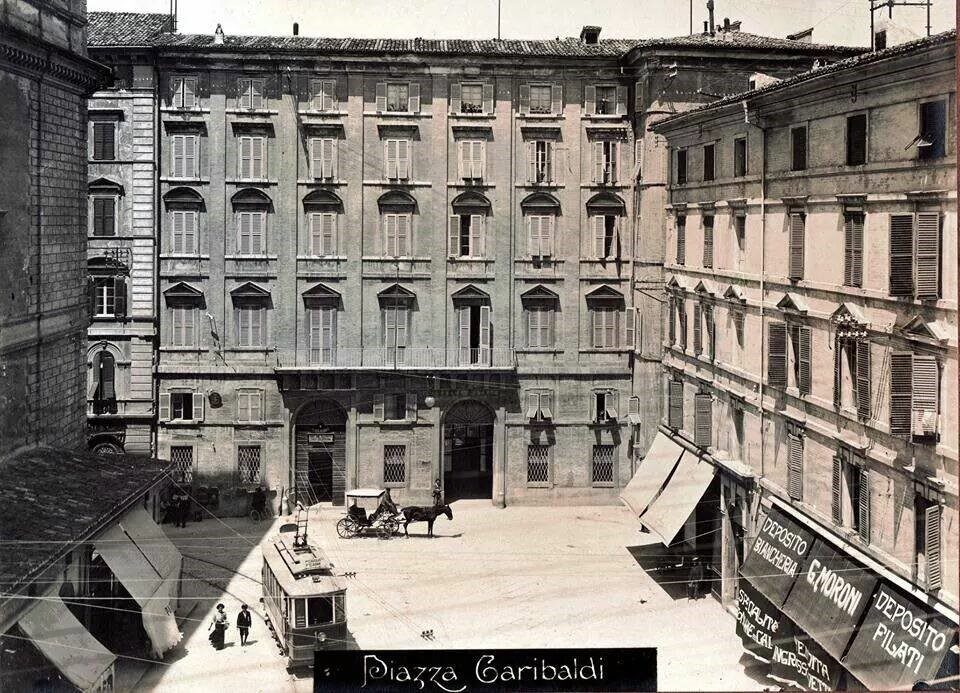
Palazzo dell’Appannaggio (no longer extant in its original form)
The building was constructed in 1789, when the space at the city entrance of the new road arriving from the north was reorganised. The resulting square was named “Piazza Nuova.” On the side that closed off the view of the sea, an imposing palazzo was erected, with a tall base supporting a giant order that carried the cornice. An alternation of geometric forms framed the rows of windows.
The palazzo initially housed the “Albergo Reale,” which later became the “Albergo della Fenice,” before serving as the administrative headquarters of the Royal Appanage – hence its name. Its function was to manage the ecclesiastical properties that Napoleon Bonaparte, by decree of 15 March 1810, had confiscated from the Church and religious institutions and assigned to the maintenance of the Viceroy of Italy, Eugène de Beauharnais, and his court — from which the term “Appanage” derives.
It hosted Prince Eugène on several occasions during his visits to the city, and in 1831 it also welcomed Napoleon Louis, the future Emperor Napoleon III, and his mother Hortense – Eugène’s sister – who had come to the aid of her son, compromised in the revolutionary uprisings of that year.
After Italian unification, it became the headquarters of the National Bank and subsequently of the Bank of Italy. Renovated in the 1920s by the renowned architect Guido Cirilli, it was completely demolished and rebuilt in its present form following the extensive damage sustained during the Second World War bombings. It continues to house the Bank of Italy branch to this day.
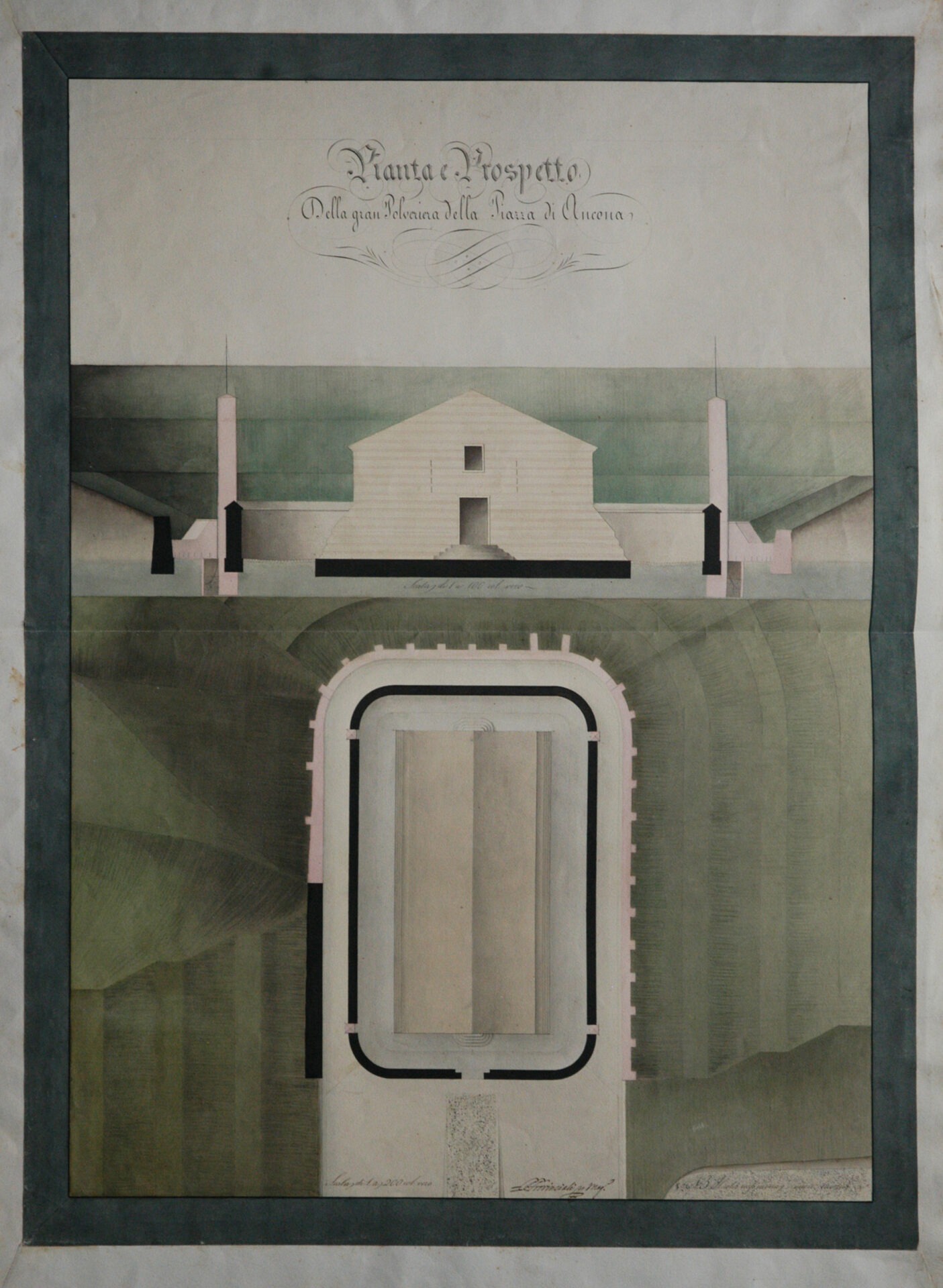

Powder Magazine “Beato Amedeo”
Located in the Cittadella Park, on the eastern slopes of the hill, it was built between 1811 and 1812 to supply the artillery of the Fortress during the French occupation.
Made necessary by the need to provision the artillery of the imposing defensive complex of the Fortress, it was constructed during the period of the city’s occupation by the troops of Emperor Napoleon Bonaparte. It consists of a single chamber with a mezzanine, capable of holding 430,000 kilograms of gunpowder and 21,400,000 cartridges. The sloping roof, covered with earth, made it “bombproof” – that is, able to withstand bombardment.
The design is the work of Military Engineer Captain Gouville, drawn up in 1811 according to the principles established by the Marquis de Vauban, one of the greatest military engineers of all time. It was already completed by the following year. It is named after the Duke of Savoy Amadeus IX, who reigned from 1465 to 1472, pursuing a policy always subject to the will of France. Virtually disinterested in public life, he renounced the throne and retired to Vercelli, where he devoted himself to the care of the needy. He was beatified in 1678.
In the 1970s, following the Italian Army’s abandonment of the Citadel structures, the powder magazine was used for a time by the Ancona branch of the Italian Shooting Union. It currently lies in a state of neglect, although the structure remains substantially intact.

Villa di Colle Ameno
Built in 1795 as the summer residence of the Camerata family, it stands on a hilltop near the sea at Torrette.
Set on an elevation overlooking the sea, the villa rises four storeys, linked by a grand staircase in the Vanvitellian style. It contains numerous rooms in addition to the reception hall on the piano nobile. Several outbuildings served as stables and storehouses. The villa is surrounded by extensive grounds, from which an underground passage leads directly to the beach.
The villa belonged to the Counts Camerata, a family well known in Ancona also for their sympathies towards the French. Antonio Camerata served as podestà of Ancona during the Napoleonic Kingdom of Italy. When Viceroy Eugène de Beauharnais visited Ancona on 27 October 1810, he was a guest of the Camerata family at the Villa di Colle Ameno.
The bond with the Bonaparte family continued even after the Emperor’s death: on 17 November 1824, Count Filippo Camerata-Passionei married Elisa Napoleona Baciocchi, daughter of Elisa Bonaparte – Napoleon’s sister – who came to live in Ancona.
In 1908, Luigi Rocchi Camerata Passionei, having no heirs, donated the entire complex to a religious order in Ancona.
It was subsequently acquired by Belgian nuns of the order of the Canonesses Regular of Saint Augustine, who were later succeeded by the Sisters of the Daughters of Charity (Canossian Sisters), who transformed the villa into a boarding school for girls, naming it “Stella Maris.” Abandoned after the earthquake of 1972, it was purchased by the Archdiocese of Ancona-Osimo, which converted it into a pastoral centre. It currently serves as a holiday house.

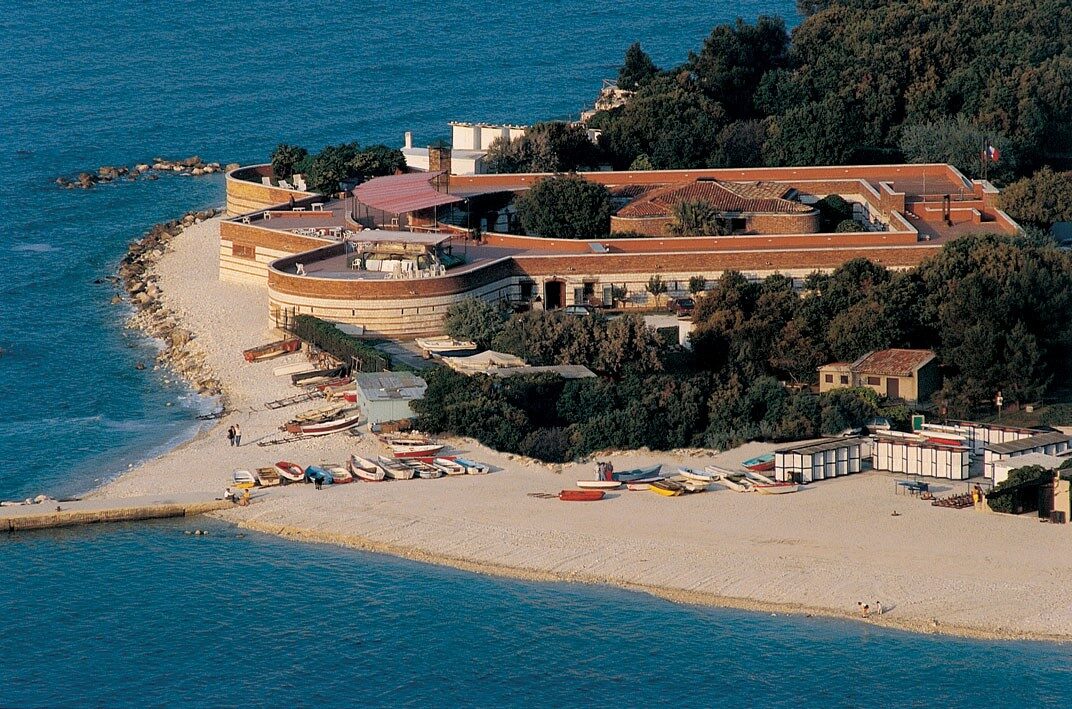
Napoleonic Fort
Built in 1811 in the bay of Portonovo from white Conero stone, the fort has a pentagonal plan with its base facing the gorge. Two caponiers extended from the sides towards the sea, while the front of attack was fitted with embrasures for cannons. It could accommodate up to 600 soldiers and formed part of the French system of fortifications in the Ancona area.
During the war between France and England, with the blockade of the Adriatic ports and English raids from the island of Lissa, the defence of the bay was reinforced to prevent the British from obtaining supplies from the spring at Portonovo. On 2 May 1811, the English attempted a landing but were repelled. The fort was probably built using stone from the Benedictine monastery next to the church of Santa Maria.
After Italian unification, it was abandoned and fell into ruin. Restored in the 1960s, it now houses a hotel and restaurant overlooking the bay.

