
ATRIUM Itinerary – Ancona in the Twentieth Century: Architecture, Memory and Urban Landscape
A walking tour through the heart of the city to discover how Ancona was transformed in the early decades of the twentieth century, through public buildings, civic spaces and monuments that still shape the face of the city today.
- Duration: approx. 1 hour
- Distance: approx. 3 km
- Starting point: War Memorial (Passetto)
- End point: Casa del Mutilato (city centre)
- Difficulty: easy
The Story Behind the Route
Perched between the Adriatic Sea and the hills of the Conero, Ancona is a city shaped by water, stone and trade. Over more than two thousand years, its architecture has absorbed Roman, medieval, Renaissance and modern influences, reflecting its role as a port city, a cultural crossroads and a place of encounter.
Ancona is part of the ATRIUM European Cultural Route – Architecture of Totalitarian Regimes of the XX Century in Europe’s Urban Memory – a Cultural Route certified by the Council of Europe. The network connects cities across Europe that share a heritage of twentieth-century architecture linked to totalitarian regimes, promoting a critical and informed reading of that legacy, grounded in democratic values and shared memory.
The Ancona itinerary is the local contribution to this European narrative: a walk that invites visitors to read the city with new eyes, recognising in its stones a history that belongs to everyone.
Between the 1920s and 1930s, Ancona experienced a period of profound urban transformation. New public buildings rose in the city centre, a grand tree-lined boulevard was laid out towards the sea, and a majestic monument crowned the Passetto headland. These places, now fully woven into the daily life of Ancona’s residents, still speak, in stone and volume, of that season of change.
This itinerary follows them in sequence, guiding visitors along the main urban axis of the modern city.
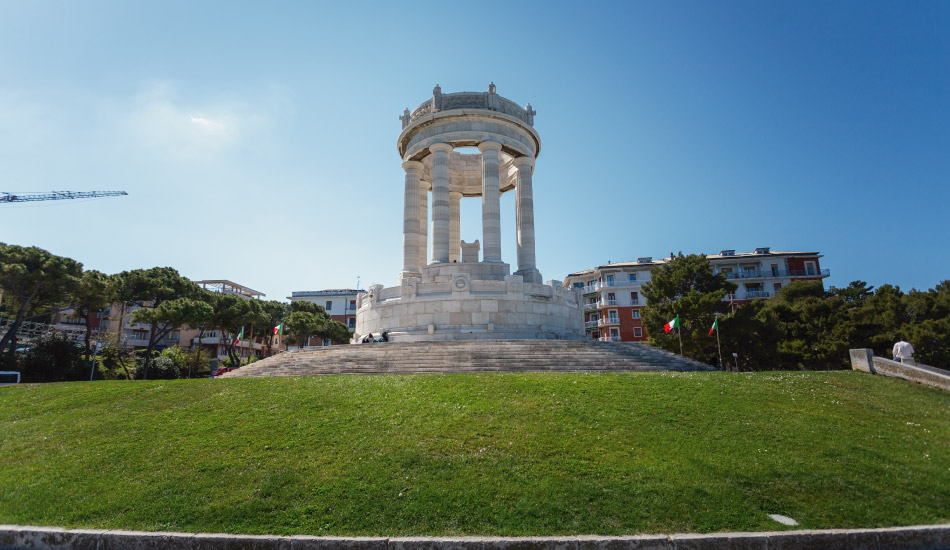
War Memorial (Monumento ai Caduti del Passetto)
Piazza IV Novembre, Passetto · Memory in the Landscape
The final stop of the itinerary is one of Ancona’s most iconic sites. The War Memorial at the Passetto, designed by Guido Cirilli and built between 1927 and 1930, closes the perspective of Viale della Vittoria with a circular plan composition set on a high base: eight Istrian stone columns support a continuous entablature inscribed with verses from Giacomo Leopardi’s poem All’Italia. At the centre of the colonnade, a large altar serves as the symbolic focal point of the space.
The position on the headland is no coincidence: the monument overlooks the Adriatic and, seen from the coast, takes on the celebrated silhouette of an eagle with spread wings, formed by the colonnade and the flanking staircases. The monumental ramps descending towards the sea integrate city and coastline in a breathtaking visual sequence, making the area one of Ancona’s most loved and frequented public spaces — for everyday walks and civic commemorations alike.

Viale della Vittoria
From Passetto to Cavour’s Square · A Boulevard Towards the Sea
More than a simple stop, Viale della Vittoria is the backbone of the entire itinerary: a great tree-lined boulevard, laid out according to the 1914 Urban Plan and consolidated in the 1920s and 1930s, connecting the historic centre to the Passetto headland with a direct perspective towards the sea.
Walking beneath the double row of trees, visitors can observe the compact façades of the period’s residential buildings, their sober geometries and restrained decorations composing a unified architectural sequence. The boulevard is not just a route: it is a public space where history meets everyday life, strolling, shopping and the rhythms of the city.

Stadio Dorico
Viale della Vittoria · A Space for Collective Experience
Along the boulevard stands the Stadio Dorico, inaugurated in 1931 on the site of the former National Shooting Range. The monumental entrance portal of the old range has been preserved as the threshold of the new sports facility. The oval plan, low volumes and regular lines engage in dialogue with the surrounding urban axis.
Recognised as a heritage site of historical and architectural interest since 2017, the stadium is currently undergoing an extensive redevelopment project aimed at renewing its role as an open sports and community space. A place that, though transformed over time, retains a strong identity and a deep connection to the sporting memory of the city.

Palazzo del Popolo
Piazza Ventiquattro Maggio 1 · Architecture and Power
The building that houses Ancona’s City Hall is one of the most representative civic buildings of the twentieth-century city. Constructed between 1929 and 1932 to a design by architect Amos Luchetti Gentiloni, it displays the hallmarks of Italian rationalism: compact volumes, sober lines, a façade clad in local stone with the central portal as its focal element. Some original decorative features are still visible on the façade, offering a telling trace of the building’s historical layers.
From a seat of local political power, the palazzo became the home of the municipal administration after the war, changing function and meaning while retaining its architectural authority.
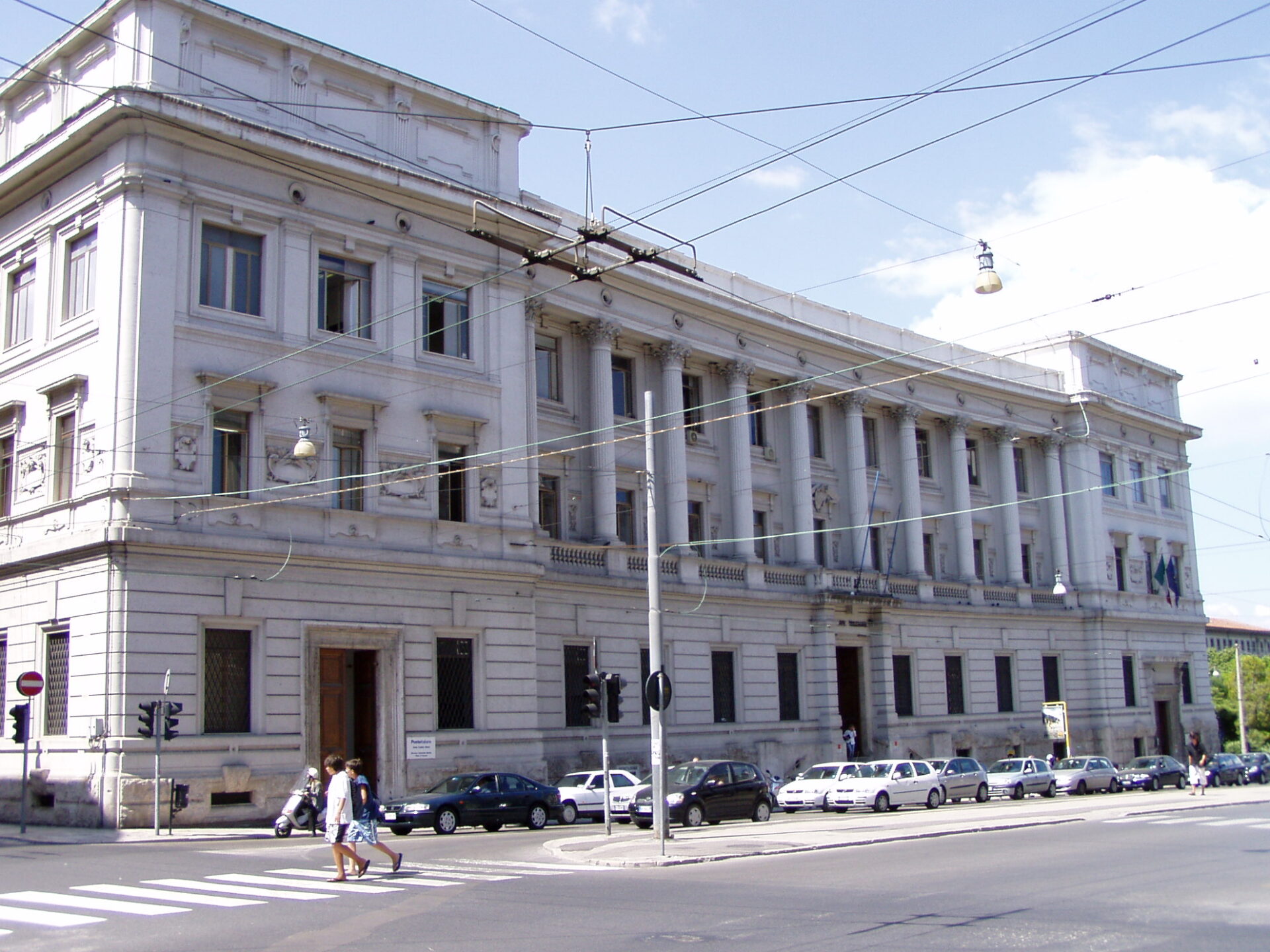
Post Office Palace
Piazza Ventiquattro Maggio · Modern Life and Communication
A few steps from the City Hall, the “Palazzo delle Poste” is another work by architect Guido Cirilli, completed between 1926 and 1929. The mixed masonry structure, travertine on the lower levels, yellow tufa on the upper floors, rises with a uniform vertical rhythm that gives the building solidity and urban presence.
The interiors, with their marbles, mosaics and stucco work, and the bas-reliefs by Angelo Conti on the external façades, make the building an extraordinary document of public architecture of the era. A conservation restoration completed in 2013 restored clarity to the original design. The palazzo still operates today as the city’s main post office.
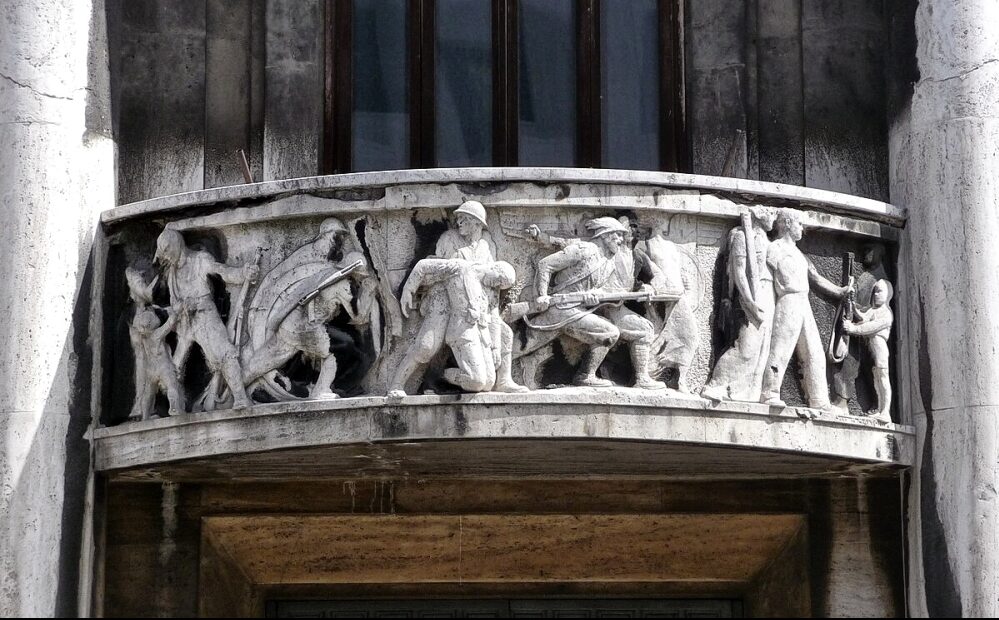
Casa del Mutilato
Corso Stamira 9 · Architecture, Care and Memory
Heading along Corso Stamira, visitors encounter the Casa del Mutilato, built from 1937 to a design by architect Angelo Eusebio Petetti. The building was part of the urban reorganisation plan that accompanied the creation of this new civic axis, expressed in a language of simplified classicism with compact volumes and clean surfaces.
Its most significant feature is the arengario: the monumental balcony created by Ancona artist Mentore Maltoni, flanked by sculptures and high reliefs evoking themes of memory, honour and civic duty. The interiors preserve notable works of art, including the Winged Victory in Carrara marble by Sanzio Blasi and a relief of Saint Sebastian in the ceremonial hall on the raised floor. Today the building is the subject of a valorisation project envisaging a new cultural use.
Before You Go
The route is entirely on foot and runs through the city centre. The starting point is a short walk from Piazza Roma.
The visit to the Passetto can be complemented by a stop at the Passetto Caves, the distinctive natural caves carved into the cliff face, used for centuries as shelters by local fishermen, accessible directly from the monument’s staircase.
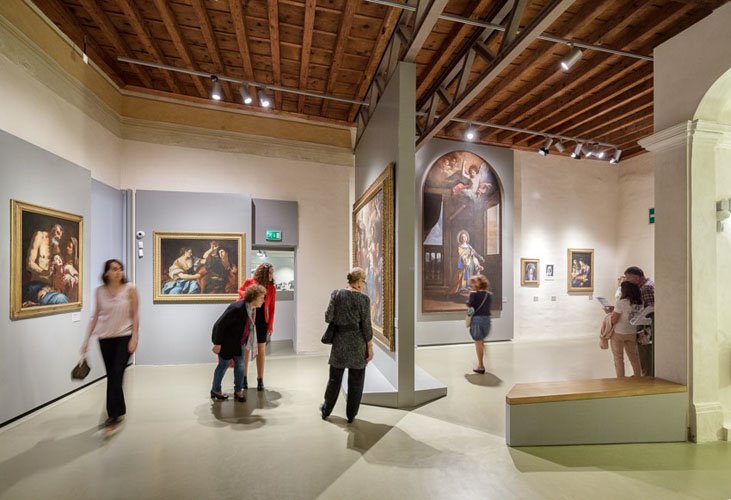
For those wishing to explore the city’s artistic heritage further, the Civic Art Gallery “Francesco Podesti” (Via Ciriaco Pizzecolli 17) holds, among other works, a number of sculptures by Mentore Maltoni that complete the visual narrative of this period.

Ancona, Italian Capital of Culture 2028
This itinerary is part of the cultural programme of Ancona Italian Capital of Culture 2028, which places the city and its heritage at the heart of a renewed dialogue between history, identity and the future. Discovering the twentieth-century architecture of Ancona means taking part in that story.

